
The deliverable
What a solar inspection report actually looks like
Below is a composite example — the real structure, with fictional property and equipment details — so you can see how findings are presented before you order one.
Not a real property, customer or inspection.
View the accessible HTML version of this report →
Having difficulty accessing this document? If you need assistance or the information in another accessible format, call us at 951-900-4999. We're happy to help.
Four pages from the sample
Rendered from the composite example itself. The property, the owner, the equipment and the findings are all invented.
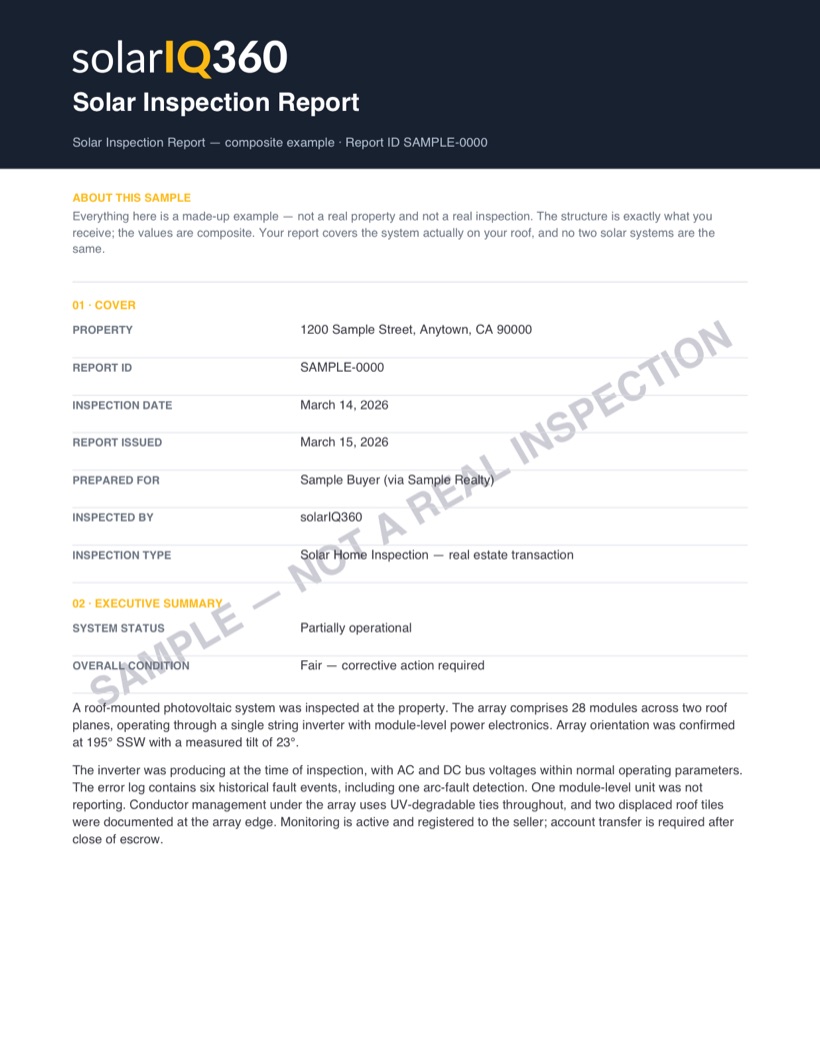
How the report is organized
Every report follows the same spine, so a realtor who has read one knows where to look in the next.
- Cover
- Property, prepared-for, inspector, date and report ID.
- Executive summary
- System status, overall condition, and a plain-language narrative.
- System specifications
- The measured and recorded facts about the installation.
- Photo documentation
- Grouped by subject: array, inverter, wiring, electrical, service panel, roof, labeling.
- Inverter error log & firmware
- What the system has recorded, and the firmware version it is running.
- Inspection findings
- Each condition, what it means, and how urgent it is.
- Monitoring
- What it does, who holds it, and how transfer works.
- Recommended next steps
- Priority-ordered, each with a responsible party.
Whose report this is, and what it covers
Every report is addressed to the person who paid for it and identifies the property it describes.
- Property
- 1200 Sample Street, Anytown, CA 90000
- Report ID
- SAMPLE-0000
- Inspection date
- March 14, 2026
- Report issued
- March 15, 2026
- Prepared for
- Sample Buyer (via Sample Realty)
- Inspected by
- solarIQ360
- Inspection type
- Solar Home Inspection — real estate transaction
The first page a client reads
- System status
- Partially operational
- Overall condition
- Fair — corrective action required
A roof-mounted photovoltaic system was inspected at the property. The array comprises 28 modules across two roof planes, operating through a single string inverter with module-level power electronics. Array orientation was confirmed at 195° SSW with a measured tilt of 23°.
The inverter was producing at the time of inspection, with AC and DC bus voltages within normal operating parameters. The error log contains six historical fault events, including one arc-fault detection. One module-level unit was not reporting. Conductor management under the array uses UV-degradable ties throughout, and two displaced roof tiles were documented at the array edge. Monitoring is active and registered to the seller; account transfer is required after close of escrow.
The facts, measured on site
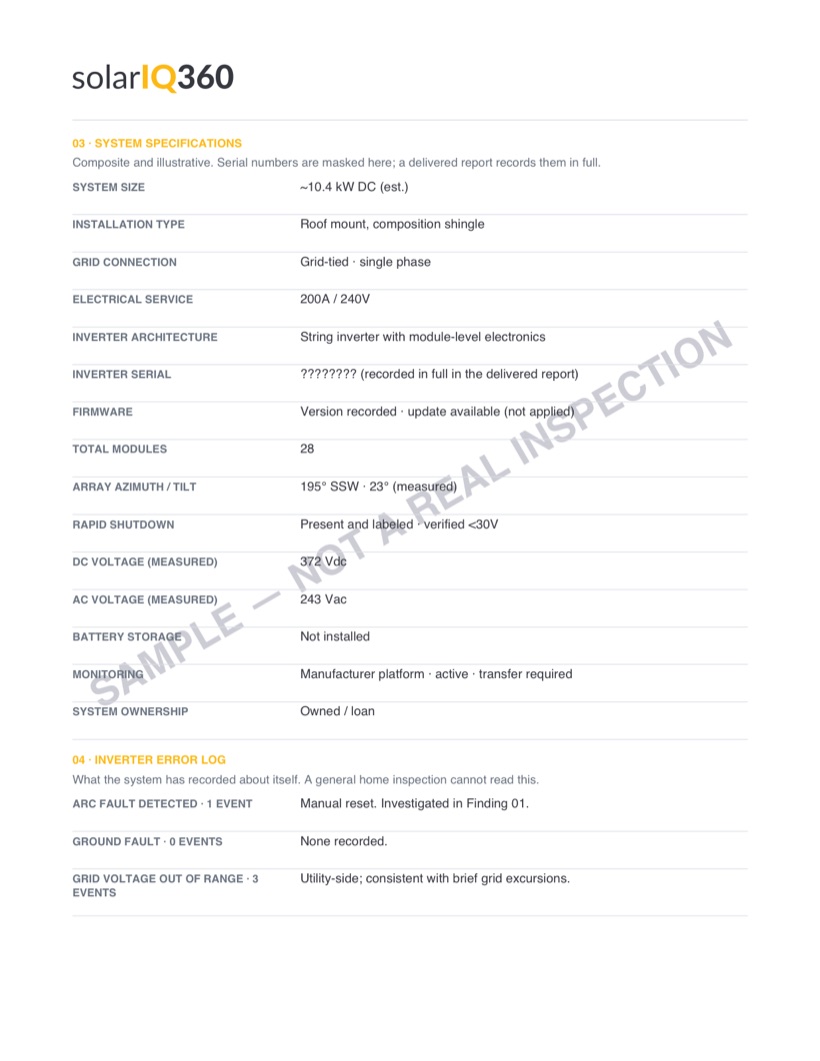
Values below are composite and illustrative. Serial numbers are masked here; a real report records them in full.
- System size
- ~10.4 kW DC (est.)
- Installation type
- Roof mount, composition shingle
- Grid connection
- Grid-tied · single phase
- Electrical service
- 200A / 240V
- Inverter architecture
- String inverter with module-level electronics
- Inverter serial
- •••••••• (recorded in full in the delivered report)
- Firmware
- Version recorded · update available (not applied)
- Total modules
- 28
- Array azimuth / tilt
- 195° SSW · 23° (measured)
- Rapid shutdown
- Present and labeled · verified <30V
- DC voltage (measured)
- 372 Vdc
- AC voltage (measured)
- 243 Vac
- Battery storage
- Not installed
- Monitoring
- Manufacturer platform · active · transfer required
- System ownership
- Owned / loan
What the system has recorded about itself
A general home inspection cannot read this. It is where an arc fault, a failing isolation reading or a unit that stopped talking shows up.
- Arc fault detected · 1 event
- Manual reset. Investigated in Finding 01.
- Ground fault · 0 events
- None recorded.
- Grid voltage out of range · 3 events
- Utility-side; consistent with brief grid excursions.
- Grid frequency out of range · 1 event
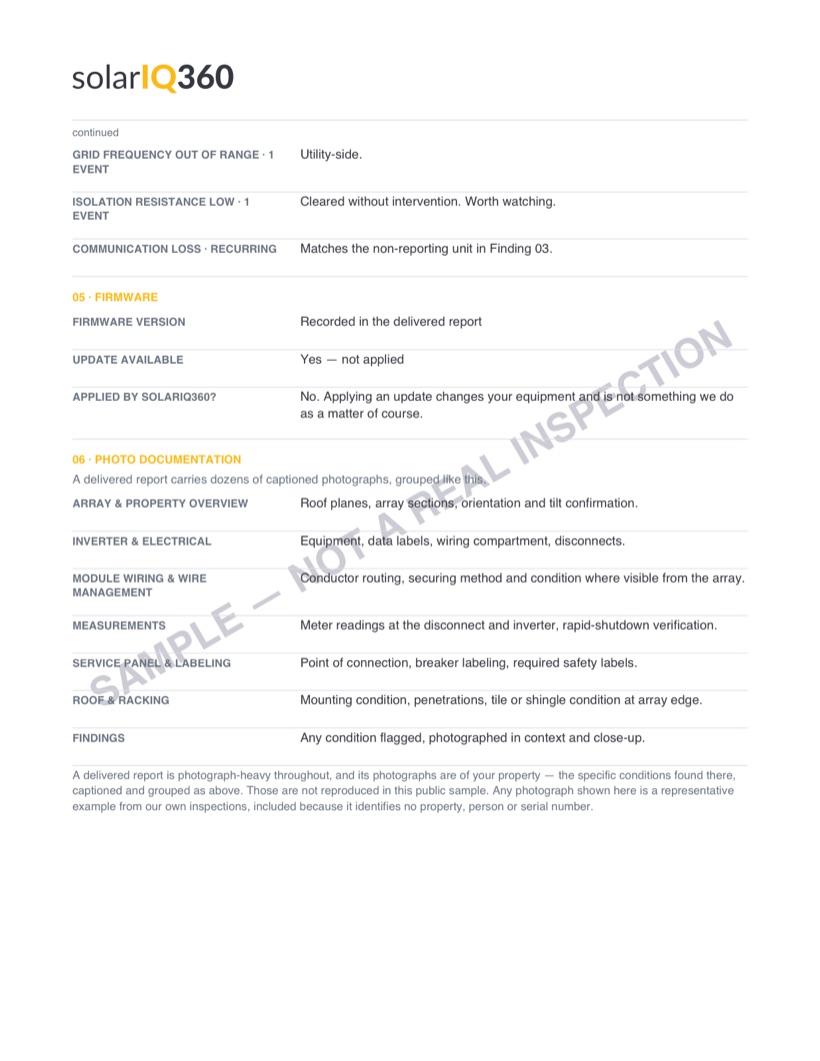
- Utility-side.
- Isolation resistance low · 1 event
- Cleared without intervention. Worth watching.
- Communication loss · Recurring
- Matches the non-reporting unit in Finding 03.
- Firmware version
- Recorded in the delivered report
- Update available
- Yes — not applied
- Applied by solarIQ360?
- No. Applying an update changes your equipment and is not something we do as a matter of course.
Extensive, and grouped by subject
A real report carries dozens of captioned photographs. This sample shows the grouping rather than reproducing property imagery.
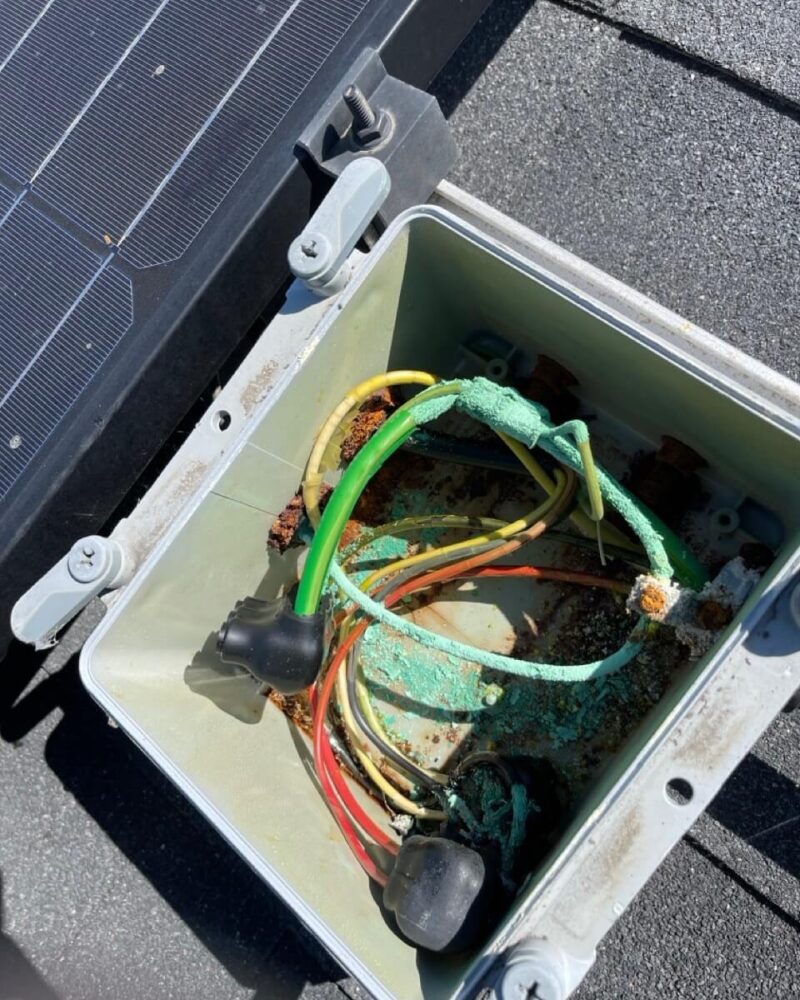
A finding, photographed close upCorrosion inside a rooftop junction box. A general home inspection does not open this, and a written note that conductors are corroded is easier to argue with than the photograph.
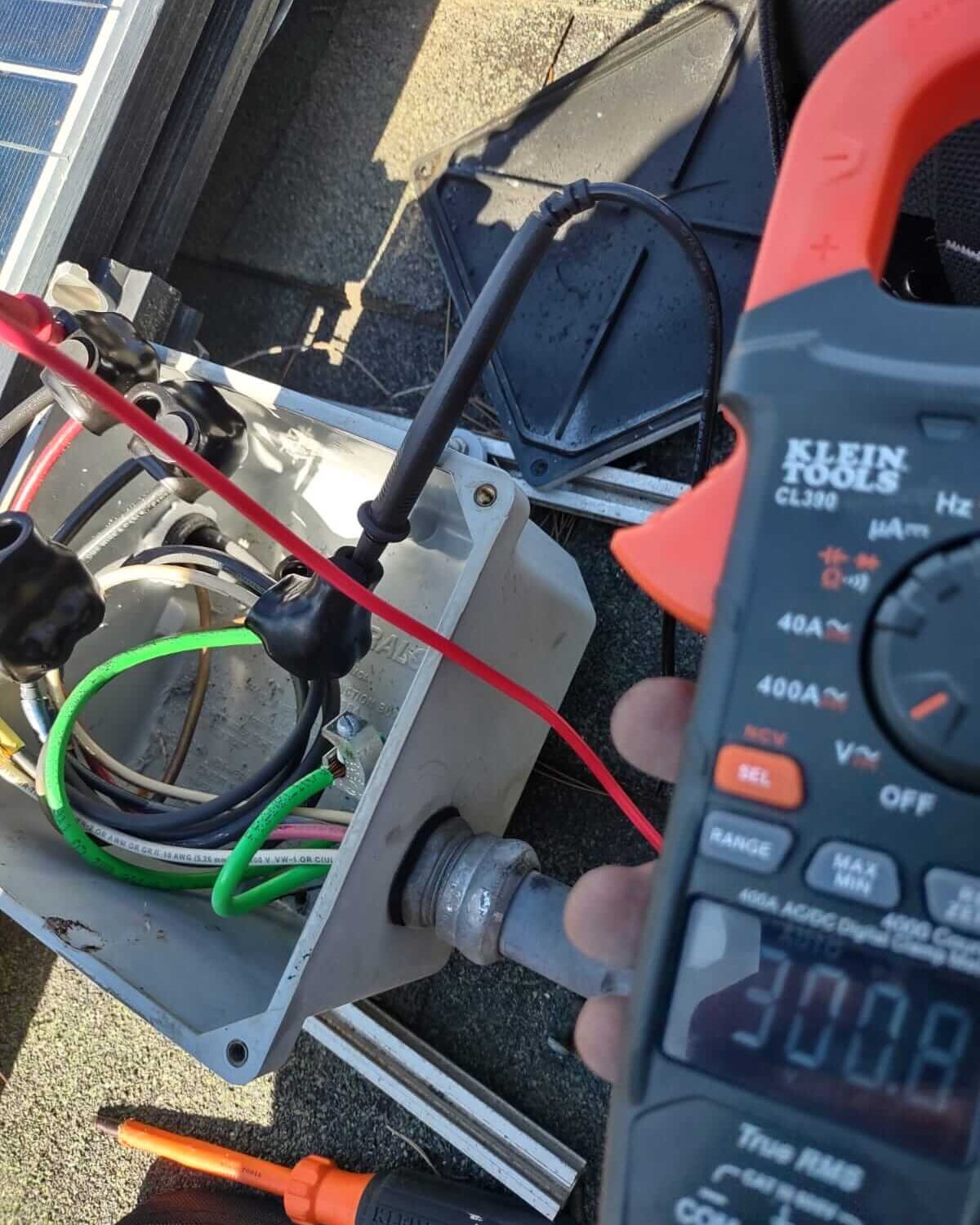
A measurement, photographed as it is takenA live reading at the point of connection. Photographing the meter beside the equipment is what turns a number in a report into something the next person can check.
What it is, and what it means
Findings are stated in the order they matter. Severity is carried by a label as well as a color, so it survives printing and screen readers.
Arc-fault detection recorded in the inverter log
The error log contains a confirmed arc-fault detection event. The detection circuit is currently set to manual reconnect, which indicates the inverter tripped and was reset by hand. The source should be investigated before close of escrow — arc faults are a fire-risk category, not a nuisance code.
Conductor management under the array
UV-degradable ties are the predominant conductor management method across both array sections. These fail over time and allow conductors to contact the roof surface, which is a recognized arc-fault precursor and a plausible contributor to the logged event above. Replacement with UV-rated clips is recommended.
One module-level unit not reporting
One power electronics unit was not reporting at the time of inspection. This reduces total system output and is typically addressed through the manufacturer's warranty or service process rather than as a paid repair.
Displaced roof tiles at the array edge
Two displaced tiles were documented adjacent to the array. Not necessarily attributable to the solar installation, but they present a water-intrusion path beneath the array. A licensed roofing contractor should assess.
Rapid shutdown present and verified
The rapid shutdown device is installed and correctly labeled. Voltage measured at the DC disconnect with rapid shutdown engaged was within the applicable threshold.
Inverter producing at time of inspection
The inverter was operating with AC and DC voltages within normal parameters. Lifetime production was recorded from the display.
The part nobody mentions at the closing table
The monitoring platform is how anyone knows the system is still working. It is almost always registered to the seller, and it does not transfer automatically. Without it the new owner has no visibility into production, faults or a unit that has quietly stopped reporting.
Confirm the platform and how it connects
Cellular, Wi-Fi or wired — each has different failure modes, and cellular plans can have a fixed term.
Request account transfer after closing
Through the manufacturer's support process. The buyer generally needs their own account first.
Verify the layout map matches the roof
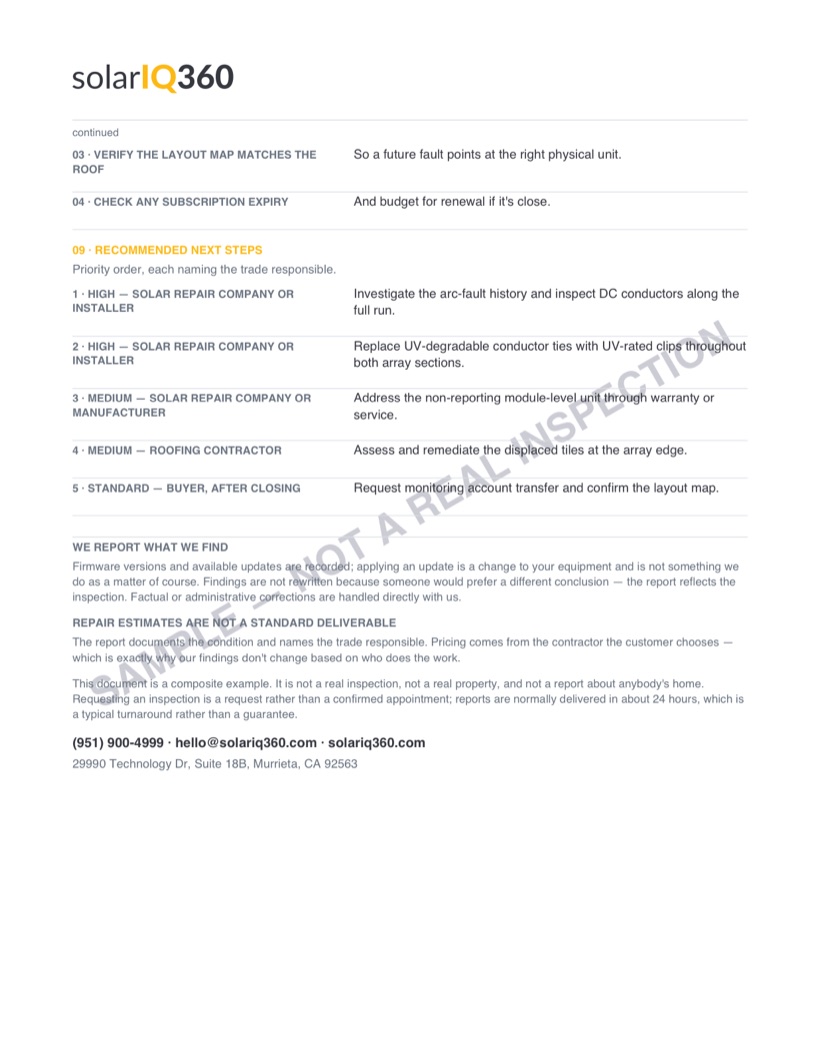
So a future fault points at the right physical unit.
Check any subscription expiry
And budget for renewal if it's close.
Priority order, with the responsible party named
- 1 · High — Solar repair company or installer
- Investigate the arc-fault history and inspect DC conductors along the full run.
- 2 · High — Solar repair company or installer
- Replace UV-degradable conductor ties with UV-rated clips throughout both array sections.
- 3 · Medium — Solar repair company or manufacturer
- Address the non-reporting module-level unit through warranty or service.
- 4 · Medium — Roofing contractor
- Assess and remediate the displaced tiles at the array edge.
- 5 · Standard — Buyer, after closing
- Request monitoring account transfer and confirm the layout map.
View the accessible HTML version of this report →
Having difficulty accessing this document? If you need assistance or the information in another accessible format, call us at 951-900-4999. We're happy to help.
Working a weekend transaction? So are we
The office is open Monday–Friday 9am–6pm, but inspections run on weekends and requests are open around the clock. We'll call to confirm the date and time.
Requesting an inspection isn't a confirmed appointment — we'll contact you to confirm timing.